
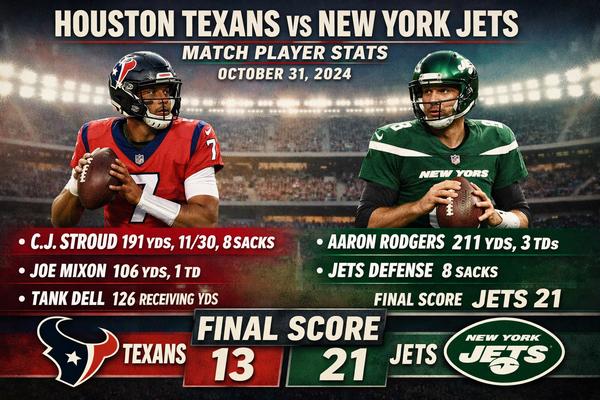
You remember that Thursday night game when everything felt slightly off for Houston and completely revived for New York? Yeah, that one. October 31, 2024. The New York Jets beat the Houston Texans 21–13, and the stat sheet tells a much deeper story than the scoreboard.
If you only glanced at the final score, you probably shrugged and moved on. But once you break down the individual player numbers, you start seeing momentum swings, protection breakdowns, and quarterback pressure that completely flipped the game. So let’s talk about it properly.
Contents
- 1 Game Overview: Jets 21, Texans 13
- 2 Quarterback Performance Breakdown
- 3 Running Game Analysis
- 4 Receiving Corps Impact
- 5 Defensive Dominance: The Real Story
- 6 Key Momentum Swings
- 7 Statistical Comparison Table
- 8 Why the Jets Won
- 9 Tactical Breakdown
- 10 Individual Player Grades (Opinion-Based)
- 11 What This Game Revealed
- 12 Broader Implications
- 13 Comparing Quarterback Styles
- 14 Could Houston Have Won?
- 15 Fan Takeaways
- 16 Final Thoughts
Game Overview: Jets 21, Texans 13
The Jets entered this matchup desperate for a reset. They carried a losing skid and needed leadership from Aaron Rodgers. The Texans arrived with confidence behind rookie sensation C.J. Stroud, who had already built a reputation for composure.
The final score landed at 21–13 in favor of New York. The Jets leaned on quarterback efficiency and defensive dominance. The Texans struggled under constant pressure, and that pressure shaped every major offensive stat.
Now let’s unpack everything position by position.
Quarterback Performance Breakdown
Aaron Rodgers – Command Under Pressure
Rodgers stepped onto the field and controlled the pace immediately. He finished with:
-
211 passing yards
-
3 passing touchdowns
-
No catastrophic mistakes
-
Efficient red-zone execution
He didn’t throw for 350 yards. He didn’t need to. He attacked matchups, trusted his reads, and punished coverage mistakes.
When the Jets entered the red zone, Rodgers finished drives. That efficiency separates average quarterback play from winning quarterback play. He read Houston’s defensive looks quickly and got the ball out before pressure developed.
You could see the difference in rhythm. Rodgers looked comfortable. Stroud looked rushed.
C.J. Stroud – A Rough Night
Stroud endured one of the toughest defensive fronts he had faced all season. He posted:
-
191 passing yards
-
11 completions on 30 attempts
-
0 passing touchdowns
-
8 sacks taken
Eight sacks. That number alone tells you the story.
The Jets defensive line overwhelmed Houston’s offensive protection. Stroud never settled into a clean pocket. He constantly reset his feet, scrambled, or absorbed contact.
Stroud didn’t implode. He competed. But constant pressure eroded timing, and timing drives passing efficiency.
Running Game Analysis
Joe Mixon – Houston’s Bright Spot
Joe Mixon gave Houston a pulse on the ground. He delivered:
-
106 rushing yards
-
1 rushing touchdown
Mixon attacked interior gaps and forced New York’s defense to respect the run. He kept Houston within striking distance longer than the passing game did.
When Houston needed a spark, Mixon answered. He broke tackles. He churned for extra yards. He extended drives.
But here’s the problem: Houston couldn’t build play-action rhythm because Stroud rarely enjoyed protection stability.
Jets Ground Game – Complementary, Not Explosive
The Jets didn’t dominate on the ground, but they stayed balanced. They used the run strategically to avoid predictable third-and-long situations.
New York’s offensive approach felt methodical. They never forced hero-ball moments. They trusted Rodgers to close drives through the air.
Receiving Corps Impact
Tank Dell – Houston’s Deep Threat
Tank Dell delivered the most explosive receiving performance of the night. He recorded:
-
126 receiving yards
Dell stretched coverage vertically. He created separation on intermediate routes. He forced the Jets secondary to respect speed.
But here’s the thing: yardage without touchdowns doesn’t flip games.
Houston moved the ball between the 20s. The Jets finished inside the 20.
Jets Red Zone Targets
Rodgers distributed the ball effectively inside scoring territory. He didn’t rely on one receiver. He trusted matchup advantages.
That balanced attack prevented Houston from double-covering any single weapon. When Rodgers spreads the field like that, defensive coordinators lose sleep.
Defensive Dominance: The Real Story
The Jets defense controlled this matchup. They applied relentless pressure. They disrupted protection schemes. They forced Houston into uncomfortable down-and-distance scenarios.
The headline stat?
8 sacks against C.J. Stroud.
That doesn’t happen by accident.
Pass Rush Impact
The Jets defensive front collapsed pockets consistently. They didn’t just pressure Stroud; they compressed his throwing lanes.
Stroud never looked settled. Every quarterback relies on timing. When timing disappears, completion percentages drop.
Houston’s 11 completions on 30 attempts reflect exactly that.
Secondary Discipline
The Jets secondary prevented big red-zone breakdowns. They allowed yardage but tightened coverage when it mattered most.
That bend-don’t-break approach frustrates offenses. Houston moved the ball. New York scored.
See the difference?
Key Momentum Swings
Momentum never sits still in NFL games. This one shifted decisively in two phases:
-
Jets defensive surge in the second half
-
Red-zone efficiency by Rodgers
Houston had opportunities. They crossed midfield multiple times. But sacks and stalled drives killed rhythm.
Meanwhile, Rodgers capitalized on short fields and scoring windows.
That’s game management at its finest.
Statistical Comparison Table
Below is the complete statistical summary from the October 31, 2024 matchup.
| Category | Houston Texans | New York Jets |
|---|---|---|
| Final Score | 13 | 21 |
| Passing Yards (QB) | C.J. Stroud – 191 | Aaron Rodgers – 211 |
| Passing TDs | 0 | 3 |
| Completions / Attempts | 11 / 30 | Efficient distribution |
| Sacks Allowed | 8 | Minimal impact |
| Leading Rusher | Joe Mixon – 106 yards, 1 TD | Committee approach |
| Leading Receiver | Tank Dell – 126 yards | Balanced red-zone targets |
| Total Offensive Efficiency | Struggled under pressure | Efficient in red zone |
Why the Jets Won
You don’t need advanced analytics to understand this one.
-
Quarterback protection
-
Red-zone efficiency
-
Defensive pressure
-
Turnover avoidance
The Jets executed those four elements better.
Houston produced yardage but failed to convert it into touchdowns. That gap defines the difference between competitive and victorious.
Tactical Breakdown
Offensive Line Disparity
Houston’s offensive line broke down under blitz packages and standard four-man rushes.
Eight sacks reveal communication breakdowns and assignment errors. Protection failures ruin game plans.
The Jets offensive line, meanwhile, kept Rodgers upright. That single factor allowed play-calling freedom.
Third-Down Conversions
New York sustained drives. Houston stalled.
Rodgers converted critical third downs with quick reads and timing routes. Stroud faced third-and-long repeatedly after sacks.
Third-and-long invites pressure. Pressure invites mistakes.
Individual Player Grades (Opinion-Based)
Let’s get honest.
-
Aaron Rodgers – A-
Efficient, decisive, clutch in red zone. -
C.J. Stroud – C
Battled hard but struggled under relentless pressure. -
Joe Mixon – B+
Delivered consistency and effort. -
Tank Dell – B
Created explosive plays but lacked scoring impact. -
Jets Defense – A
Controlled tempo and dictated outcome.
IMO, the Jets defense earned the game ball.
What This Game Revealed
Houston showed promise but lacked protection stability.
New York proved that veteran quarterback leadership still matters in tight matchups.
Rodgers didn’t chase highlight reels. He executed fundamentals.
Stroud didn’t collapse. He endured a harsh lesson about elite defensive fronts.
And honestly, those lessons shape playoff-caliber quarterbacks.
Broader Implications
For the Texans, this game highlighted one immediate priority: protect the quarterback.
Stroud can’t operate under siege every week. Offensive line adjustments must follow.
For the Jets, this game restored confidence. Rodgers demonstrated that when healthy and protected, he elevates the entire offense.
The defensive front validated its ability to dictate outcomes against emerging quarterbacks.
Comparing Quarterback Styles
Stroud thrives on rhythm and timing.
Rodgers thrives on reading leverage and exploiting defensive hesitation.
When protection falters, timing quarterbacks struggle more than improvisational veterans.
That dynamic shaped this matchup.
Could Houston Have Won?
Absolutely.
If Houston limits sacks to three or fewer, this becomes a one-score game deep into the fourth quarter.
If Houston converts one red-zone drive into a touchdown instead of stalling, the momentum shifts.
But football doesn’t reward “if.”
It rewards execution.
Fan Takeaways
If you root for Houston, you probably left frustrated but optimistic.
If you root for New York, you probably felt relief.
Both reactions make sense.
The Texans showed flashes. The Jets showed composure.
Final Thoughts
The Houston Texans vs New York Jets Match Player Stats from October 31, 2024 tell a clear story.
-
Rodgers executed efficiently.
-
Stroud faced relentless pressure.
-
Joe Mixon carried offensive balance.
-
Tank Dell stretched coverage.
-
The Jets defense controlled the trenches.
-
Red-zone execution decided the game.
The final score reads 21–13, but the stat sheet explains why.
Football rarely hides the truth. Pressure wins games. Efficiency seals them.
And if you ever wonder whether eight sacks matter, just revisit this matchup.